
Tidbits · Hecate
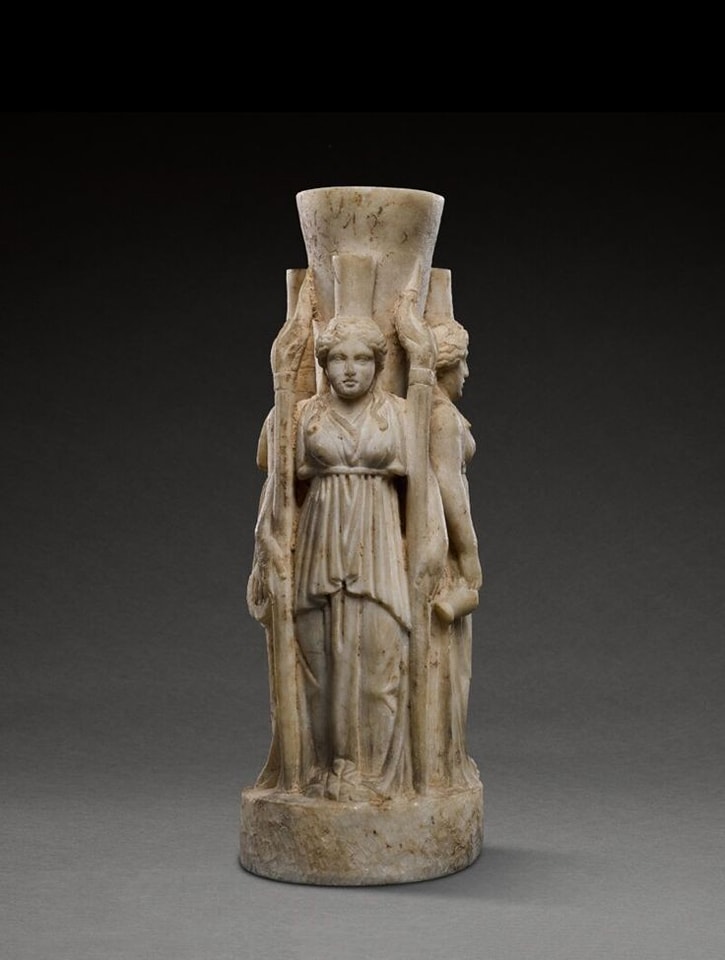
A rare invocation of Hecate Chthonia, preserved – of all people – by a Christian bishop who wanted to expose the tricks of magicians.
- Source: Hippolytus, Refutation of All Heresies 4.35.5
- Language: Greek of the Roman period
- Use: an invocation for the dark moon and for Hecate’s Supper (Deipnon)
This ancient hymn to Hekate was saved by the Christian theologian Hippolytus. It is little known even among those who honor the goddess today – and since our aim is to share rare material from the ancient texts, we are happy to present it here. The hymn can be used to invoke the goddess at her Deipnon, the Supper, or to call on her darker aspects during the waning moon.
Who was Hippolytus?
Hippolytus (c. AD 170–235) was a Greek-speaking scholar and a student of Irenaeus, bishop of Lyon. Trained in ancient philosophy, he wore the tribon, the cloak of the philosophers. After becoming a Christian he used his learning to defend the faith against the many sects of his day. He served as a bishop in Rome from 222 until 235, when the emperor Maximinus Thrax exiled him to Sardinia, where he died a year later from harsh treatment.
The Orthodox Church honors him as a saint on 30 January, the Catholic Church on 13 August.
A lost book, found on Mount Athos
His most important work was the Refutation of All Heresies, in ten books. For centuries most of it was lost – until in 1842 a large part was rediscovered in a monastery on Mount Athos in Greece. The hymn survives in this work. Its unknown author used many epithets to address the goddess, an Orphic characteristic, and the ending is strongly influenced by the Orphic Hymn to Hekate. It was probably part of a ritual of burnt offerings to Hekate Chthonia – and it can easily be used at the offering of her Supper.
The invocation
Ancient Greek · Hippolytus, Refutation 4.35.5
εινοδίη, τριοδίτι, φαεσφόρε, νυκτερόφοιτε,
εχθρή μεν φωτός, νυκτός δε φίλη και εταίρη,
χαίρουσα σκυλάκων υλακή τε και αίματι φοινώ,
εν νέκυσιν στείχουσα κατ’ ηρία τεθνηώτων,
αίματος ιμείρουσα, φόβον θνητοίσι φέρουσα,
Γοργώ και Μορμώ και Μήνη και πολύμορφε,
έλθοις ευάντητος εφ’ ημετέρησι θυηλαίς.
Lexicon for Greek readers
Νερτέριος = υποχθόνιος, μολέ = ύπαγε-έλα, νυκτερόφοιτε = περιπλανώμενη τη νύχτα, εταίρη = συντρόφισσα, φοινός = βαθυκόκκινος, στείχω = περπατώ-πορεύομαι, ηρίον = τύμβος, μνήμα, τάφος με λόφο, ιμείρομαι = λαχταρώ, ευάντητος = φιλικός, προσηνής, θυηλαίς = οι θυσίες που γίνονται με φωτιά, δηλαδή όταν καίμε τμήματα ζώου προς τιμήν των χθονίων θεών. Για να χρησιμοποιήσετε την επίκληση στο δείπνο, αλλάξτε την τελευταία λέξη σε προσφοραίς.
English translation
Einodia, Trioditis, Phaesphoros, Nykterophoitos,
enemy of light, friend and companion of night,
you who delight in the howling of dogs and in dark red blood,
who walk among the dead, between the tombs,
who long for blood and bring fear to mortals,
Gorgo, Mormo, Mene, many-formed one,
come to meet us with good will at our burnt offering.
The names of the goddess
- Nerteria · Chthonia · Urania
- of the underworld · of the earth · of the sky
- Brimo
- the angry one
- Einodia · Trioditis
- of the roads · of the three roads
- Phaesphoros · Nykterophoitos
- light-bringer · night-wanderer
- Gorgo
- here the monster with golden wings, copper hands, tusks and snakes for hair, who turns to stone all who see her – one of the most frightening monsters of all
- Mormo
- a monster who drinks blood, eats hearts and brings illness and death, more commonly called Lamia. Like Hecate she could change her form. Gorgo and Mormo connect Hecate with the dark side of her nature – which is why this invocation suits the waning moon, when her chthonic aspects are called
- Mene
- Selene, the moon goddess. Mene gives us the word “month”: the ancient Greeks counted their months by the cycle of the moon
- Polymorphe
- of many forms
Text and translation: Constantinos Nterziotis.


