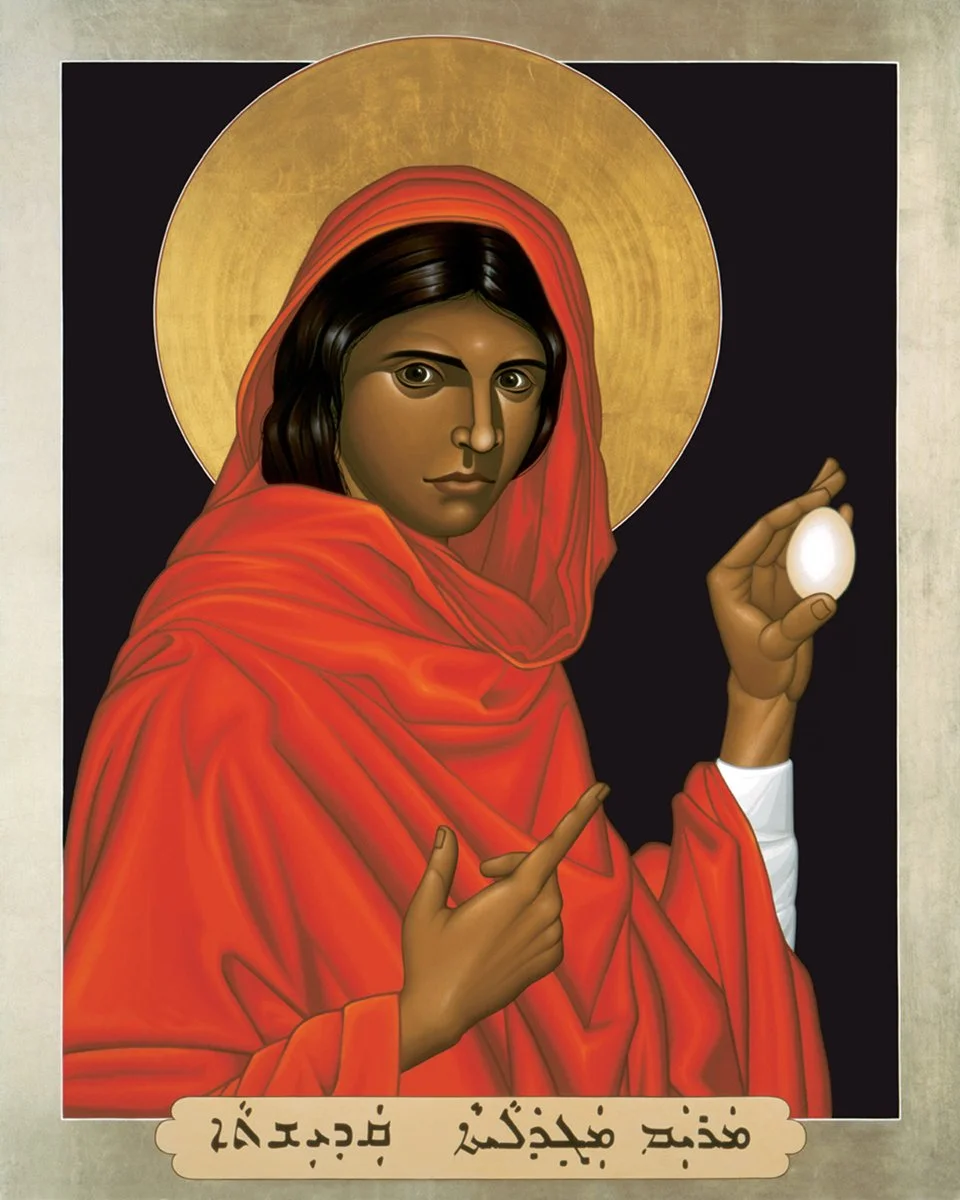
In Eastern Orthodox and some Catholic traditions, Mary Magdalene is believed by some to have lived for a time in Ephesus, together with Apostle John and the Mother Mary.
This belief is rooted in early Christian memory that associates John’s later ministry with Ephesus, one of the most important cities of Roman Asia Minor and a major center of early Christianity.
According to tradition, after the Crucifixion, Jesus entrusted Mary to John (John 19:26–27). Many Church Fathers understood this as John taking responsibility for her care. When John later settled in Ephesus, Mary was believed to have accompanied him.
Because Mary Magdalene is closely associated with the early apostolic circle—especially in the Resurrection narratives—later tradition places her within this same Ephesian Christian community.
Gregory too had knowledge of this practice: “[John the Evangelist] . . . descended into a tomb while he was still alive and ordered that he be covered in the ground. Still today his tomb produces manna with the appearance of flour; blessed relics of this manna are sent throughout the entire world and perform cures for ill people” (Glor. mart. 29). These “blessed relics” that contained the manna are likely the ampullae that have been found in various sites near Ephesus. Some of these ampullae depict a scene of a seated man writing; scholars have identified the man as John, though it may instead be John’s disciple Prochorus. Also located in Ephesus is the tomb of the Seven Sleepers (whose story is told in Glor. mart. 94) and the body of Mary Magdalene, which was later translated to Constantinople. Gregory mentions both of these in passing. “Manna” flows also out of the tomb of Andrew (30), located in Patras, Gregory says, “where the blessed apostle and martyr was crucified” as in the Acts of Andrew.