
The Sanctuary of Artemis was the preeminent religious heart of Sardis and the focus of the city’s ancestral cults, with overlapping and evolving syncretic beliefs1. These cults could have been existed long before the temple – even the present massive altar – was built (fig. 1). Their presence shaped the sanctuary and the temple over centuries in ways large and small, first when the temple came to being solely as a cella in the early third century BC, then when it was re-created during the Roman Imperial period as an unorthodox pseudodipteros housing the dual cults of Artemis and the emperors (fig. 2). Although the sanctuary and the temple belonged to Artemis foremost, kindred deities, especially Artemis and Cybele/Kybebe, who shared attributes and identities, might well have overlapped across the sacred geography of the setting2. As poetically recalled in Sophocles’ chorus in Philoctetes, “Kybebe, Mother of Gods,
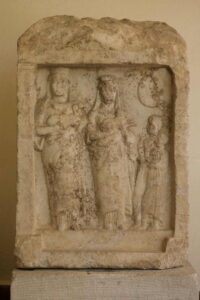
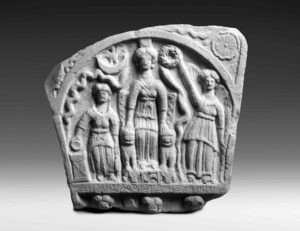
Mother of the Mountains (Meter Oreia), who dwells by the gold-bearing Pactolus”, watches with Artemis the great Tmolos range surrounding the site3. A votive stele discovered in Sardis in 1968 depicts in high relief Artemis and Kybebe standing next to each other within a pedimented shrine as they are approached by a pair of worshippers (fig. 3). The scene underscores the similarity and closeness as well as, the separateness of the two deities. Although there are no inscriptions from the Sanctuary of Artemis that specifically name Kybebe, as true for the relief above, the goddesses and their worshippers share the iconography, the same space and are united religiously and architecturally4. Artemis might have shared her sacred geography also with other deities5. A long inscription dated to 1-5 BC, found in the Sanctuary of Artemis in 1912, honors a prominent Sardian named Menogenes and refers to “those dwelling in the sanctuary of Zeus Polieus and Artemis”6. The clarity of this passage compelled Butler to open many trenches around the temple in search of another great temple, all in vain. Some half century later, G.M.A. Hanfmann believed that this cult of Zeus had been absorbed into the Temple of Artemis by ca. 220 BC enjoying joint worship in an architecturally divided, dual-cella temple – a theory now shown to have no basis. Extensive investigations by Butler and George M.A. Hanfmann revealed no earlier temple under or close to the present one. Although this enigmatic Zeus cult and other protean cults were associated with the changing traditions of the sanctuary, the boundaries of the sacred area, extending between the acropolis and the Pactolus River, remains uncertain. Primarily, this land must have been sacred to Artemis, the preeminent goddess of Sardis, from the earliest days as attested by an archaic altar, which was enlarged during the Hellenistic period and connected to the west front of the newly built cella7. An inscription dubbed as the “sacrilege inscription” suggests that for the sources of the ancient cult at Sardis we must look to Ephesus and its venerable cult of Artemis8.