


Discovered by Photographer Ara Güler

- the battle scene


Sacred Sites · Caria · UNESCO World Heritage
In the fertile valley of the Morsynus River lies Aphrodisias: a city of marble, of master sculptors, and of a goddess unlike any other Aphrodite.
- Where: upper valley of the Morsynus River, ancient Caria
- Temple of Aphrodite: 3rd century BC; the city about a century later
- Wealth: its marble quarries and its sculptors
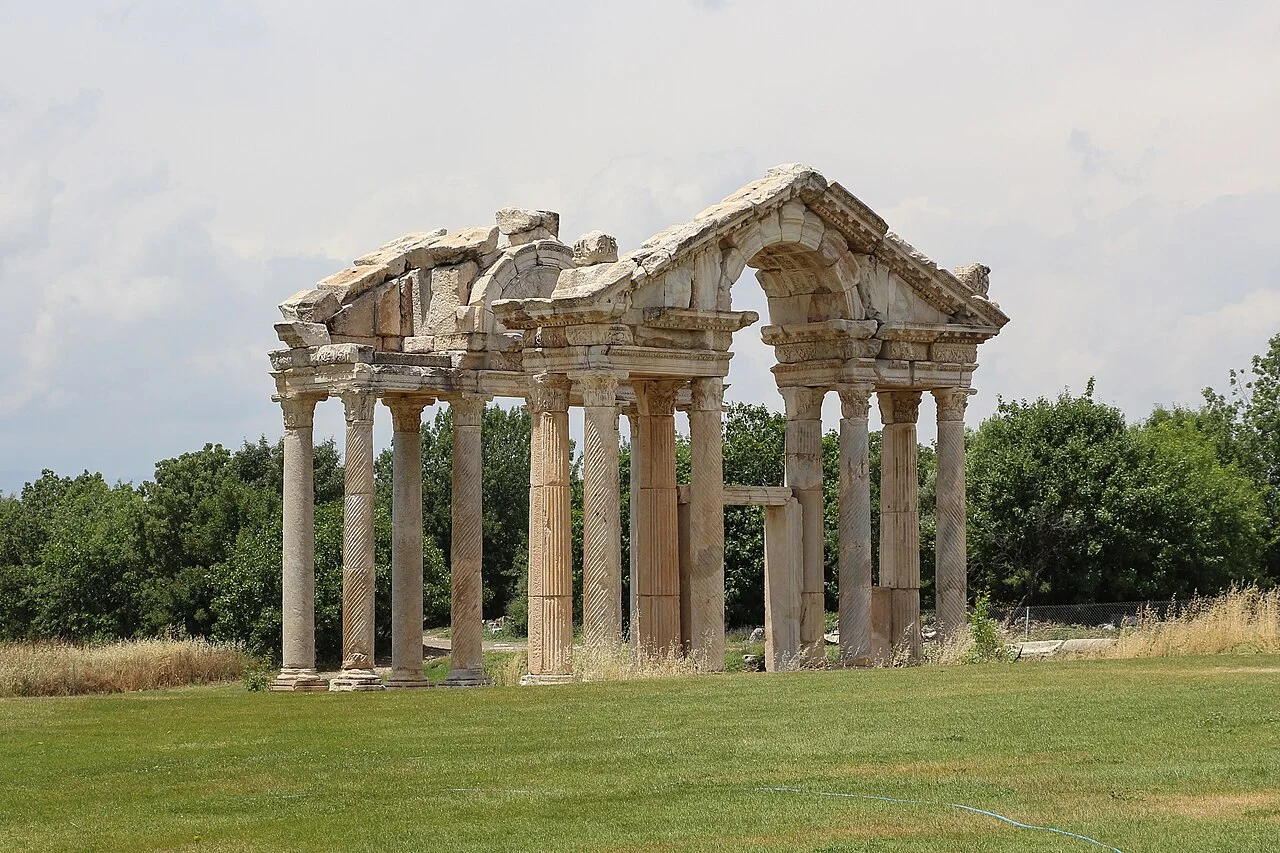
- Must see: Sebasteion, Theatre with the Archive Wall, Stadium, Tetrapylon
- Inscriptions: about 2,000 survive
A city and its quarries
Located in southwestern Turkey, Aphrodisias consists of two closely related parts: the archaeological city itself and the marble quarries to the northeast. The Temple of Aphrodite dates to the 3rd century BC, while the city was founded about a century later as a city-state, planned on an orthogonal street grid; only a few buildings, notably the Temple of Aphrodite, deviate from it.
Aphrodisias drew its wealth above all from its marble and from the exceptional work of its sculptors. The city is organised around great civic monuments: temples, a theatre, an agora and two large bath complexes.
The favourite of Rome
Because the city shared a special devotion to Aphrodite with Sulla, Julius Caesar and the emperor Augustus, Aphrodisias developed close ties with Rome. The Roman Senate granted it a privileged tax-free status, and in the Imperial period it became a major centre of art and sculpture. Many richly decorated public buildings were built at this time, all of local marble.
The cult of Aphrodite
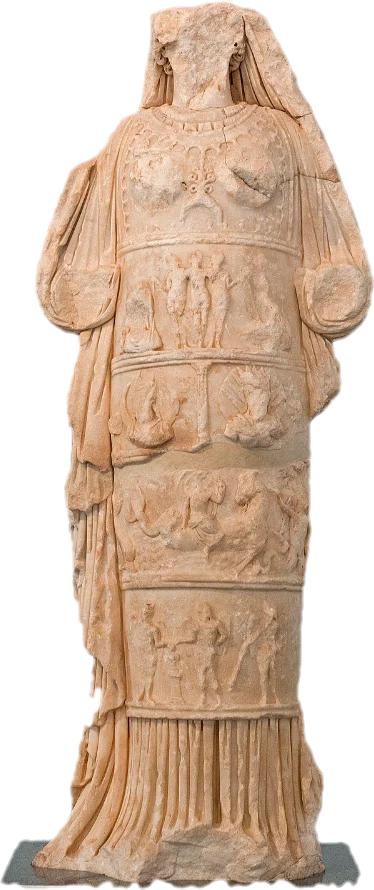
The cult of Aphrodite was central to the city’s identity. Her sanctuary housed a distinctive cult statue that fused a local Anatolian fertility goddess with the Hellenic goddess of love and beauty. Images of her have been found across Anatolia and throughout the Mediterranean, from Rome to the Levant.
Remarkably, her cult endured long after Christianity became the official faith: the Temple of Aphrodite was not converted into a church until around AD 500.
Marble and sculpture
The nearby quarries of fine white and grey marble made Aphrodisias an outstanding centre of sculpture. Its sculptors were famous across the Roman Empire for their virtuoso portraits and their Hellenistic-style gods and Dionysian figures. Their signatures appear on some of the finest works in Rome itself, including sculptures from Hadrian’s Villa at Tivoli.
In Late Antiquity (4th–6th centuries AD) they were in high demand for imperial portraits and honorific statues in Sardis, Stratonikeia, Laodikeia, Constantinople and Rome, and were regarded as the finest marble carvers of the age. The site also contains one of the very few systematically excavated sculpture workshops of the Roman Empire.
A cosmopolitan city
Aphrodisias was remarkably mixed: Greek, Roman, Carian, pagan, Jewish and Christian, as some 2,000 surviving inscriptions vividly show.
Monuments not to miss
- Sebasteion
- A cult complex for Augustus and the Julio-Claudian emperors, blending Hellenistic, Roman and local traditions.
- Theatre
- With the “Archive Wall”, an extraordinary collection of imperial documents, and an early aediculated stage façade.
- Stadium
- With its rare curved ends, the best-preserved structure of its kind in the ancient world.
- Temple of Aphrodite
- Its transformation into a cathedral around AD 500 is unique in its engineering and spatial effect.
- Tetrapylon
- The entrance to the sanctuary, with exquisitely carved ornament.
For the curious: the UNESCO World Heritage file
Outstanding Universal Value
Criterion (ii): The marble sculpture of Aphrodisias is a synthesis of local, Greek and Roman traditions, themes and iconography, from monumental architectural decoration to over-life-size statues and small votive objects. Between the 1st and 5th centuries AD its sculptors played a leading role in the imperial art market.
Criterion (iii): Aphrodisias holds a pre-eminent place in the study of Roman sculpture; its quarries and workshops made it a major artistic hub.
Criterion (iv): An exceptional example of a Greco-Roman city in inland Asia Minor, with several monumental marble buildings of unique design.
Criterion (vi): In antiquity the city was famed as the cult centre of a distinctive Aphrodite, combining Anatolian fertility traditions with Hellenic ideals of love and beauty, whose images spread across the Mediterranean.
Integrity and authenticity
The property includes all elements needed to convey its value and has not been affected by major geomorphological change or intensive modern occupation. Its boundaries cover both the city and the quarries. Authenticity is shown by the preserved quarries, monuments, sculptures and inscriptions and by extensive research; conservation follows the Venice Charter. The surrounding landscape remains largely untouched by modern development and mass tourism.
Protection and management
Legal protection has been in place since 1978 for the ancient city and since 1981 for the quarries (Act No. 2863), strengthened for the quarries in 2016; it should be extended to the whole buffer zone, with expanded gendarmerie patrols. The Ministry of Culture and Tourism, its regional branches and the excavation team are responsible, and greater involvement of the local community is recommended. A Conservation Plan was approved in 2002 and a Management Plan in 2013; both should be updated. A 3D inventory of the quarry faces is needed. The main natural risks are seasonal flooding and summer wildfires: a drainage plan within the walls should be implemented urgently, together with a fire response plan, staff training and interim measures such as mobile water tanks.


